In this monthly report, FPM looks in detail at what the CQC have publicly reported from their GP practice inspections during April 2026, all anonymised. We highlight some of the behaviours that won practices Outstanding ratings, and the reasons some practices were scored Requires Improvement, or Inadequate. Do you recognise any of the observations the CQC picked up, either good or bad?
'OUTSTANDING' COMMENTS AND PRAISE FROM THE CQC (scores of 4)
EFFECTIVE:
-
Assessing needs: One practice was a pioneer in using the NHS-supported approach, year of care, to managing long-term conditions (LTC), for example for diabetes. This moved focus from a single, doctor's appointment to a personalised, two-part care planning process. The same practice introduced a housebound LTC visiting service in 2025. The practice recognised the gap in the district nurse provision; whilst being aware they had a higher-than-average elderly population.
-
Supporting people to live healthier lives: a practice introduced a self-check in pod in reception, encouraging them to manage their own health. The practice - a 'deep end practice' due to the high levels of deprivation - completed a healthier lives project in collaboration with the Deep End Network and Newcastle University. The practice employed a link worker to build relationships with patients over the phone to support them to attend for health checks, which they normally would not engage with.
-
Monitoring and improving outcomes: one practice had a 2-cycle audit on the prescribing of antibiotics to patients with a lower respiratory tract infection. There was a two-cycle audit of the pneumococcal vaccination uptake among patients with learning disabilities.
Click the image below to view the full report:
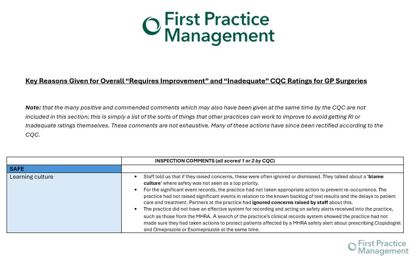
'REQUIRES IMPROVEMENT' / 'INADEQUATE' RATINGS (scores of 1 or 2):
SAFE:
-
Safeguarding: One practice had a safeguarding policy, but it lacked information about who staff could report concerns to in addition to the safeguarding lead. Others did not know how many children were under a child protection plan; or had 77 children on a mental health register without any valid clinical reasons being listed.
-
Safe and effective staffing: this again was one of the most common areas that practices scored poorly. In one practice, no proof of identity checks were seen in 5 staff files reviewed by CQC and only 1 staff file had evidence of references obtained prior to starting employment. Elsewhere, some reception staff were completing clinical triage with no formal training - and this was consistent with patient complaints that they were told by non-clinical staff that their test results looked fine when they were not.
- Medicines optimisation: a provider had no sharps box in the resuscitation equipment bag when he CQC checked during the site visit. Another had no risk assessments completed for emergency medicines that were not carried by the service such as naloxone and atropine. Elsewhere, vaccines were being inappropriately stored in sample fridges, whilst medicines reviews did not contain details about the review itself and they were also not coded as medicine reviews.
Stericycle offers sharps waste disposal solutions - click here to learn more.
-
Safe systems, pathways and transitions: one practice had thousands of unactioned tasks, tens of thousands of unprocessed documents and thousands of unactioned pathology results. Other bad behaviours included lack of any prioritisation for cancer referrals.
- Involving people to manage risks: examples include an anaphylaxis kit containing two 23G needles instead of the four recommended; adrenaline was not stocked in all rooms where vaccines were administered, and elsewhere not all clinical and non-clinical staff were up to date with essential training, including anaphylaxis, sepsis and basic life support.
CARING:
-
Kindness, compassion and dignity: patients reported being spoken to in a condescending manner; several patients said they felt scolded by some GPs. CQC received complaints from patients regarding lack of privacy at the front desk. Patients said they were required to discuss personal medical issues and provide sensitive information in a loud voice through thick plastic screens at reception.
-
Treating people as individuals: One patient diagnosed with a mental health condition described the consistently poor experience they had when in crisis, leaving them distressed and unable to access the medication they required - this resulted in patients becoming upset at the reception desk or having to bring family members to support them at the practice.
-
Responding to people’s immediate needs: young children requiring urgent assessment and care were turned away from the practice by the lead GP because they were presented late in the day and staff expressed their disappointment with this. On the day of assessment, we observed one child under 5 years old was turned away from the practice when they requested a morning appointment. Elsewhere, a vulnerable patient requiring enteral tube feeding did not receive prescribed nutrition for 2 days.
RESPONSIVE:
-
Providing information: Patients were advised to contact the practice prior to their appointment so they could arrange to have a BSL interpreter when required. However, when we looked at accessibility arrangements for individuals, we saw there was no hearing loop in the practice at the time of assessment.
-
Equity in access: Appointments were released daily at 8am but were often fully booked within approximately 16 minutes. This was consistent with patient feedback. Many patients stated they were advised to attend the practice in person and queue from 8am, which was not feasible. Shockingly, some patients reported taking annual leave or multiple days off work just to secure an appointment, describing the system as not viable as a service for patients.
-
Equity in experience and outcomes: patients with long-term conditions were not allowed to raise more than 1 issue during their appointments but had to request another appointment when accessing the service was already an issue. One practice had no accessibility policy and no provisions for their blind or partially sighted patients when attending appointments.
Make sure your policies are up to date and read and understood by all staff with FPM Core - the market- leading compliance system for primary care.

0 Comments