
In this monthly report, FPM looks in detail at what the CQC have publicly reported from their GP practice inspections during February 2026. Only the most notable/useful comments are selected for readers from amongst thousands. We highlight some of the behaviours that won practices Outstanding ratings, and the reasons some practices were scored Requires Improvement, or Inadequate. Do you recognise any of the observations the CQC picked up, either good or bad?
SOME 'OUTSTANDING' COMMENTS AND PRAISE FROM THE CQC:
Safe:
-
Safeguarding: the practice provided an outreach vehicle with a dedicated staff team, to engage and visit homeless people and others, and it also doubled as a women’s safe space on Friday evenings.
-
Medicines Optimisation: staff provided proactive support with medications - e.g. those who were advised to take aspirin throughout pregnancy but were unsure of how to access the medication; flexible prescribing, liaison with community pharmacy and the use of dosette boxes.
Caring:
- Kindness, compassion and dignity: At one practice, supplies were available for patients to access in the waiting areas such as shoes, coats, sleeping bags and umbrellas. The practice worked closely with other services to ensure patients had access to essentials such as food parcels and toiletries.
-
Workforce wellbeing and enablement: The practice had recently introduced annual staff awards to acknowledge areas such as rising star employee of the year. There was also an award which was named in remembrance of staff member who had sadly passed away during the COVID 19 pandemic. All staff were invited to attend the annual award which was hosted off site as a social event.
Responsive:
- Listening to and involving people: in response to patient feedback for more creative methods of engagement, the practice had introduced art therapy.
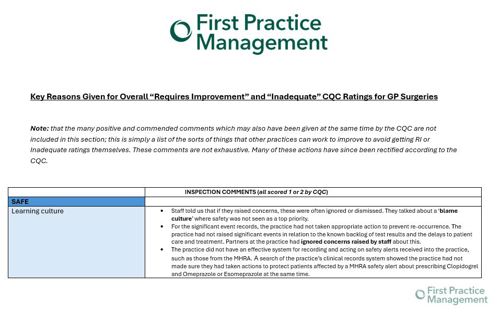
Click the image below to download the full report
SOME 'REQUIRES IMPROVEMENT' / 'INADEQUATE' RATINGS:
Safe:
-
Policies not sufficient or tailored: The provider had a complaints policy; however it was not specific to the practice and the details stated, 'insert practice name here'. The policy also did not specify how they were going to share learning. There was a significant event policy which stated that staff would be involved in learning but did not outline about how it would be achieved. A consent policy did not mention the need for 2 parents to give their consent, required by the BMA.
-
No training needs analysis: It was unclear why learning was assigned to staff groups as there was no training needs analysis
Our market leading compliance software FPM Core lets you know who has read what policies, and when, so you are always up to date with compliance - click here to book your demo today
-
Legionella checks and compliance continue to be a very common area where practices are not doing enough to be compliant.
-
Medicines optimisation remains the largest area for poor scores. Bad monitoring, no assessment of risk in some cases, not recording blank prescription cards adequately so they could not tell if any were missing, and over-prescribing of medication including antiobiotics.
-
Circumcision clinic criticisms: one practice was only reviewed under the safe category for their circumcision clinic but was rated 1 (inadequate) in terms of safeguarding, infection control and medicines optimisation, amongst other things.
- IPC audit missed bin problem: an IPC audit had not identified that purple-lidded sharps bins, required for the safe disposal of cytotoxic waste, were not available in the practice nurse’s room.
Responsive:
-
GP Partners lack of visibility: Patients raised concerns that a public meeting arranged by the practice to address concerns was not attended by any of the GP partners.
-
Digital exclusion was a concern raised by patients and the PPG. Although there were policies in place regarding accessibility, we saw evidence that these were not embedded such as reasonable adjustments not being honoured.
Click here to learn about the accessible market-leading websites that My Surgery Website can create for you.
Well-led:
-
No business continuity plan was provided to CQC by the practice.
-
Mis-recording: We saw some events where the outcome was recorded as patient error when there had been a failure in process. This meant that steps to prevent recurrence were not taken.


0 Comments