

In this monthly report, FPM looks in detail at what the CQC have publicly reported from their GP practice inspections during October 2026, all anonymised. We highlight great performance and innovation for those rated Outstanding, and also the reasons some practice's individual ratings were scored Requires Improvement, or Inadequate.
'OUTSTANDING' overall (individual scores of 4):
EFFECTIVE
-
Supporting people to live healthier lives: one practice had a dedicated services for transgender patients, ensuring they had access to appropriate, person-centred support tailored to their individual needs. They also held the Gold accreditation in Pride in Practice, and provided a dedicated Recovery Support Group, ‘Recoffery’, which runs fortnightly for patients requiring support with alcohol and substance misuse.
-
Assessing needs: one provider had a dedicated ‘missingness’ programme, through which staff actively identified patients who had not attended the practice within a specified timeframe or had not participated in recommended health checks and reviews. The practice took a proactive and holistic approach to assessing people’s needs, including visiting patients in their own homes to better understand any barriers they faced, build trusting relationships, and gain a comprehensive understanding of their individual circumstances and support needs.
CARING
-
Treating people as individuals: all staff had received training in autism and learning disabilities, providing them with the knowledge and skills to support individuals who may experience difficulties with accessing healthcare services. Staff were also provided with enhanced chaperone training, further strengthening their ability to offer personalised, compassionate, and appropriate support to patients
- Workforce wellbeing and enablement: regular team-building days and practice events, such as Employee Appreciation Day. The practice developed role-specific appreciation initiatives to ensure staff at all levels felt valued and recognised, including national receptionists’ day and nurses’ appreciation day.
-
Responding to people's immediate needs: when patients experienced a bereavement, their usual GP would contact them to offer support and condolences. This was often followed by a consultation arranged at a time and location that met the needs and preferences of the bereaved individual or family.
WELL LED
-
Capable, compassionate and inclusive leaders: Leaders were proactive in reviewing data, seeking out partner agencies and organisations that would support them in promoting the best outcomes, services and amenities for people who used the practice, such as ‘Child Mortality in Temporary Accommodation’. The ‘GM Deprivation – GPST Training Programme’ formed a robust framework to ensure equal opportunities and drive to promote and recruit people to work with patients facing health inequalities as a result of deprivation.
-
Partnerships and communities: one provider focused on the most vulnerable patients and those in poverty and deprivation. They also had a training development scheme for GP registrars to train and retain GPs who specialise in these population groups.
-
Learning, improvement and innovation: Leaders at one practice were proactive in reviewing data, seeking out partner agencies and organisations that would support them in promoting the best outcomes, services and amenities for people who used the practice, such as ‘Child Mortality in Temporary Accommodation’.
- Governance, management and sustainability: Using a live EMIS-generated list of patients who were due or overdue, one provider proactively contacted patients to encourage attendance, followed up non-responders and those who had not attended appointments, and recorded all outcomes in clinical records.
Click the image below to view the full report:
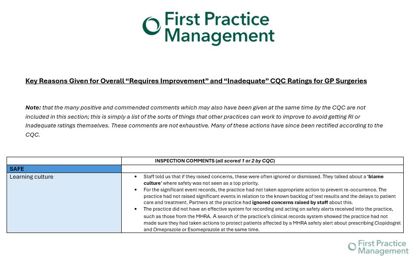
'REQUIRES IMPROVEMENT' or 'INADEQUATE 'overall (individual scores of 1 or 2):
SAFE:
- Safe environments: CQC found staff unable to clearly describe the respective roles and responsibilities of the service and the council, as owner of the building, which reduced clarity in the management of health and safety risks. The service was also unable to evidence essential safety checks had been completed, including the electrical wiring certificate and annual fire panel service. Elsewhere, an external Legionella risk assessment carried out in March 2026 had identified several actions, some of which were classified as high-risk actions requiring completion within 3 months. At the time of CQC assessment none of these actions had been addressed. At another provider, clinical rooms had no lockable doors. Some of these rooms contained clinical refrigerators, medicines and sharps.
-
Safe systems pathways and transitions: one service did not ensure that test results were reviewed without delay. During the CQC's onsite visit they identified 9 test results assigned to a staff member who was absent from work, 5 of which were identified as abnormal. During another onsite visit the CQC identified 9 test results assigned to a staff member who was absent from work, 5 of which were identified as abnormal. The service had not identified this as a risk or ensured the results would be monitored and reviewed to prevent delays in care and treatment. They only became aware of these results after CQC raised this with them.
- Infection prevention and control: poor examples included some cleaning equipment, including wet mops, being hung up and stored in the COSHH cupboard; moisture damage to the walls and flooring in the cupboard and disposable mop heads were being reused despite being intended for single use. Cleaning products, including bleach sprays, continued to be stored within a kitchen area. Cleaning records displayed within service toilets, intended to document when areas were checked and cleaned and by whom, had not been completed. One service had not ensured clinical waste was stored securely in line with NHSE and HSE standards. For example, the lock on the external door providing access to the clinical waste bins was broken which meant the area was not secure. Additionally, the bins in the storage area were also unlocked.
FPM Core's policy and procedure library contains templates for safe staffing including a Staff Screening & Immunisation Policy, Staff Handbook, and Conflict Resolution Policy - Staff.
EFFECTIVE
- Delivering evidence-based care and treatment: review of patients prescribed high numbers of asthma reliever inhalers identified records where patients had not always received care and treatment consistent with recommended asthma management guidance. In addition, records relating to medicines subject to national safety requirements did not always demonstrate that appropriate reviews, safety arrangements and risk management processes had been completed in line with current guidance.
WELL LED
- Shared direction and culture: Meeting agendas we reviewed did not have significant events as a standing agenda item which demonstrated it was not routinely discussed among staff.
-
Governance, management and sustainability: one service was unable to provide a policy or protocol to support staff in managing test results when key members of staff were absent from work. The service’s infection prevention and control (IPC) policy contained inaccurate or irrelevant information, as it referenced contact links from an NHS trust and named the incorrect IPC lead. One provider's system for reviewing and revising such policies was not clear. The practice recruitment policy did not presently reflect guidance and legislation, but the practice were working to make this compliant. Policies and standard operating procedures were difficult to find; many could only be retrieved from performing a lengthy search of digital folders. The provider told us that some staff struggled with information technology and were not able to perform the search for the document easily themselves. Policies were not kept together in a centralised place. There was no version control.
- Workforce equality, diversity and inclusion: Three out of 5 staff records the CQC reviewed did not evidence discussions had taken place regarding staff physical or mental health and wellbeing, including whether any reasonable adjustments were required.
Make sure your policies are up to date and read and understood by all staff with FPM Core - the market- leading compliance system for primary care.

0 Comments