

In this monthly report, FPM looks in detail at what the CQC have publicly reported from their GP practice inspections during September 2026, all anonymised. We highlight great performance for those rated Outstanding, and also the reasons some practice's individual ratings were scored Requires Improvement, or Inadequate.
'OUTSTANDING' overall (individual scores of 4):
CARING
-
Kindness, compassion and dignity: One practice was seen as a central hub for the local community; using additional space in the adjoining community hospital (no longer used clinically) to set up a social day unit for those experiencing isolation or loneliness. Specific groups have grown, with a men’s group, women’s group, bereavement group and mothers'/baby group.
-
Treating people as individuals: staff had set up a bespoke clinic for patients who lived in local sheltered accommodation so that they could come together with their carer.
-
Independence, choice and control: The practice co-ordinated weekly Integrated Community Ageing Team (ICAT) home visits. This demonstrated proactive care planning and supported keeping patients independent and giving them a choice in their care beyond standard GP appointments.
WELL LED
-
Capable, compassionate and inclusive leaders: the lead GP would complete out of hours visits to families of patients receiving palliative care in the local community to provide reassurance.
-
Partnerships and communities: Clinicians at the practice recognised there wasn’t a local urgent suspected cancer referral pathway. They worked with hospital teams, oncology and the ICB to raise this and support a targeted pathway to be developed.
-
Learning, improvement and innovation: clinicians reviewed all patients at the practice who were on private prescriptions for weight loss medication including Mounjaro; cross checking against whether patients were taking oral contraceptives or on Hormone Replace Therapy (HRT) for those going through menopause. At the same practice, clinicians advocated for specific EMIS searches to be added to standard audit protocols particularly in regard to cancer patients. This increased flexibility in making sure no patients were missed.
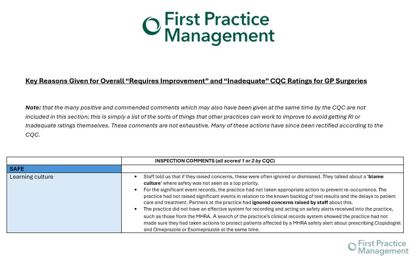
Click the image below to view the full report:
'REQUIRES IMPROVEMENT' overall (individual scores of 1 or 2):
SAFE:
-
Learning culture: one provider could not demonstrate that themes and trends were routinely analysed, translated into action plans or used to achieve sustained improvements.
-
Safe environments: Ligature risks had not been adequately identified, assessed or mitigated within consultation and treatment rooms. Window blind cords presented an avoidable ligature risk. In addition, Prescription stationery was observed unsecured in a printer within the nurse’s room, and not all fire extinguishers were safely secured.
- Infection prevention and control: Clinical equipment and supplies were stored alongside food preparation areas within a staff kitchen; the cold chain was not managed in accordance with the provider's own policy; the waste control policy stated each bag of clinical waste should be labeled but this was not being completed to ensure traceability and enable safe handling and completion of annual IPC assessments had not been undertaken prior to June 2026. The policy had not been fully completed to identify the IPC lead and minor surgery room.
FPM Core's policy and procedure library contains templates for safe staffing including a Staff Screening & Immunisation Policy, Staff Handbook, and Conflict Resolution Policy - Staff.
CARING
-
Treating people as individuals: At one practice, there was no hearing loop available, and we did not see examples of easy read information being readily available for patients.
-
Workforce wellbeing and enablement: mandatory training had not been prioritised due to workload pressures. Staff welfare facilities were limited, with no dedicated area available for staff to take breaks away from their working environment.
RESPONSIVE
-
Listening to and involving people: 1 of the 3 complaints we reviewed had not been managed in line with the practice’s policy. It did not include information of how the complainant could escalate the complaint if they were dissatisfied with how the complaint had been handled.
-
Providing Information: 50% of patients reported they knew what the next step would be after contacting the practice which was significantly below the national average of 84%.
WELL LED
-
Governance, management and sustainability: NHS Friends and Family data showed in April 2026, 30% of patients surveyed responded they would recommend one practice to family and friends.
- Learning, improvement and innovation: Leaders were unable to demonstrate that clinical audit, National GP Patient Survey results, Friends and Family Test feedback and other sources of assurance were routinely used to evaluate performance.
Make sure your policies are up to date and read and understood by all staff with FPM Core - the market- leading compliance system for primary care.

0 Comments