

In this monthly report, FPM reviews the latest GP practice CQC inspections and highlights key CQC inspection findings from July 2026, all anonymised. We highlight some of the behaviours that won practices Outstanding ratings, and the reasons some practices were scored Requires Improvement, or Inadequate. Do you recognise any of the observations the CQC picked up, either good or bad?
'OUTSTANDING' COMMENTS AND PRAISE FROM THE CQC (scores of 4)
RESPONSIVE:
-
Equity in access: A surgery operated a mixture of urgent and pre-bookable appointments and an effective monitoring system was in place, which the practice manager or the reception manager oversaw, to ensure both pre-bookable and same-day appointments were consistently available, waiting times for non-urgent appointments did not exceed 2 weeks and continuity of care was maintained whenever possible. Home visits were also available at the discretion of a GP for those patients who could not attend the surgery, thereby ensuring their continuity of care.
-
Care provision, Integration and continuity: An annual Teddy Bear GP Clinics in partnership with local schools to support early health education and reduce anxiety around healthcare environments.
- Person-centred care: One service pioneered and implemented an Autism Friendly Practice model, becoming the first practice in the borough to achieve formal accreditation. It introduced a range of tailored adjustments, including named GPs, longer appointments, environmental changes, flexible access and clear communication
EFFECTIVE
-
Supporting people to live healthier lives: At one practice, a wide-ranging physical activity and well-being offer included a practice-funded Sports Academy, developed in response to local childhood obesity data and co-designed with families. They also offered a virtual group consultation programme for chronic pain. The practice also established a monthly Health Hub, providing access to housing, financial and well-being support, recognising the impact of social determinants on health outcomes.
- How staff, teams and services work together: The service had also co‑founded an integrated adolescent GP service co‑located within the local Youth Hub. This brought primary care into a trusted community setting and created a direct clinical and administrative link between the practice, the CAMHS Alliance and the Children’s Integrated Commissioning Service. A salaried GP delivered the weekly clinic, with care linked back to primary care records, ensuring seamless continuity between the community-based service and the registered patient record.
CARING:
-
Kindness, compassion and dignity: A practice demonstrated a compassionate and proactive approach to supporting patients following bereavement. This included the introduction of a dedicated Baby Loss Support Letter, providing timely, empathetic and sensitive communication following loss.
- Workforce wellbeing and enablement: A menopause policy was in place, demonstrating a commitment to inclusivity and practical support. This was complemented by a “comfort box” located within staff facilities, providing menstrual and menopause related supplies. The service also recognised the needs of neurodiverse staff, enabling the use of headphones to listen to music during work to support concentration, reduce stress, and enhance the working environment.
Click the image below to view the full report:
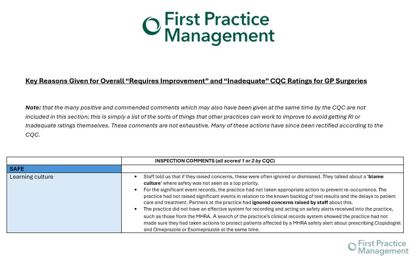
'REQUIRES IMPROVEMENT' / 'INADEQUATE' RATINGS (scores of 1 or 2):
SAFE:
- Learning Culture: at one practice, not all safety events were discussed or noted in meeting minutes. There was no recorded follow up of actions to ensure that changes had been made and were effective.
Make sure your policies are up to date and read and understood by all staff with FPM Core - the market- leading compliance system for primary care.
-
Safe and effective staffing: Non-clinical staff allocated patients to staff in advanced clinical roles based on a list of conditions. The list differentiated some conditions by severity and underlying cause, which would require clinical knowledge. This could lead to patients being inappropriately triaged to staff in advanced clinical roles rather to than GPs. (Score 1: inadequate)
FPM Core's policy and procedure library contains templates for safe staffing including a Staff Screening & Immunisation Policy, Staff Handbook, and Conflict Resolution Policy - Staff.
EFFECTIVE
-
Delivering evidence-based care and treatment: Where clinical management differed from national guidance, we did not see a documented rationale for this in the patient records. Patients received an annual review of their condition. However, we saw a record where it was not possible to evidence that the review was effective, as it did not accurately record the exacerbations the person had experienced. The provider told us that this was a documentation error. There was also no consistent system to follow up on people who did not respond to routine requests to have monitoring or review, or who were not requesting required medicines.
-
Consent to care and treatment: 2 patients did not have a DNACPR form documented in their records. It was not clear whether decisions about CPR would be reviewed at the appropriate interval.
WELL LED
-
Governance, management and sustainability: meeting minutes at one practice did not have actions agreed in the meeting clearly identified and there was no consistent, documented, follow-up of actions previously agreed. Not all clinical staff were invited to clinical meetings or received the minutes. (Score of 1 - inadequate). Effective GP practice governance remains a critical factor in achieving positive inspection outcomes.

Very useful information